Domain Control Validation (DCV): How CAs Verify Your Domain, and the Rules Changing to 2029
Before issuing an SSL certificate, a CA checks that you control the domain. Learn how DNS, HTTP and email validation work, why WHOIS and email methods are ending, and how to lock issuance down with CAA before reuse drops to 10 days in 2029.
A certificate authority (CA) decides you control a domain by testing you right now. It gives you a random value and checks, from several places on the internet, that you can publish it in your DNS, serve it from your website or present it over TLS. This check, called domain control validation (DCV), is the whole basis of a domain-validated (DV) certificate. The rules are tightening: WHOIS-based methods are gone, email and phone methods end by 2028, and from March 2029 a CA may reuse a past validation for only 10 days.
Key takeaways
- DCV proves control of a name at one moment, not legal ownership. Whoever controls your DNS or web server can pass it.
- The methods that will remain are a DNS record, a file on your website, and a special certificate served on port 443 (TLS-ALPN-01). Of these, only DNS can validate a wildcard.
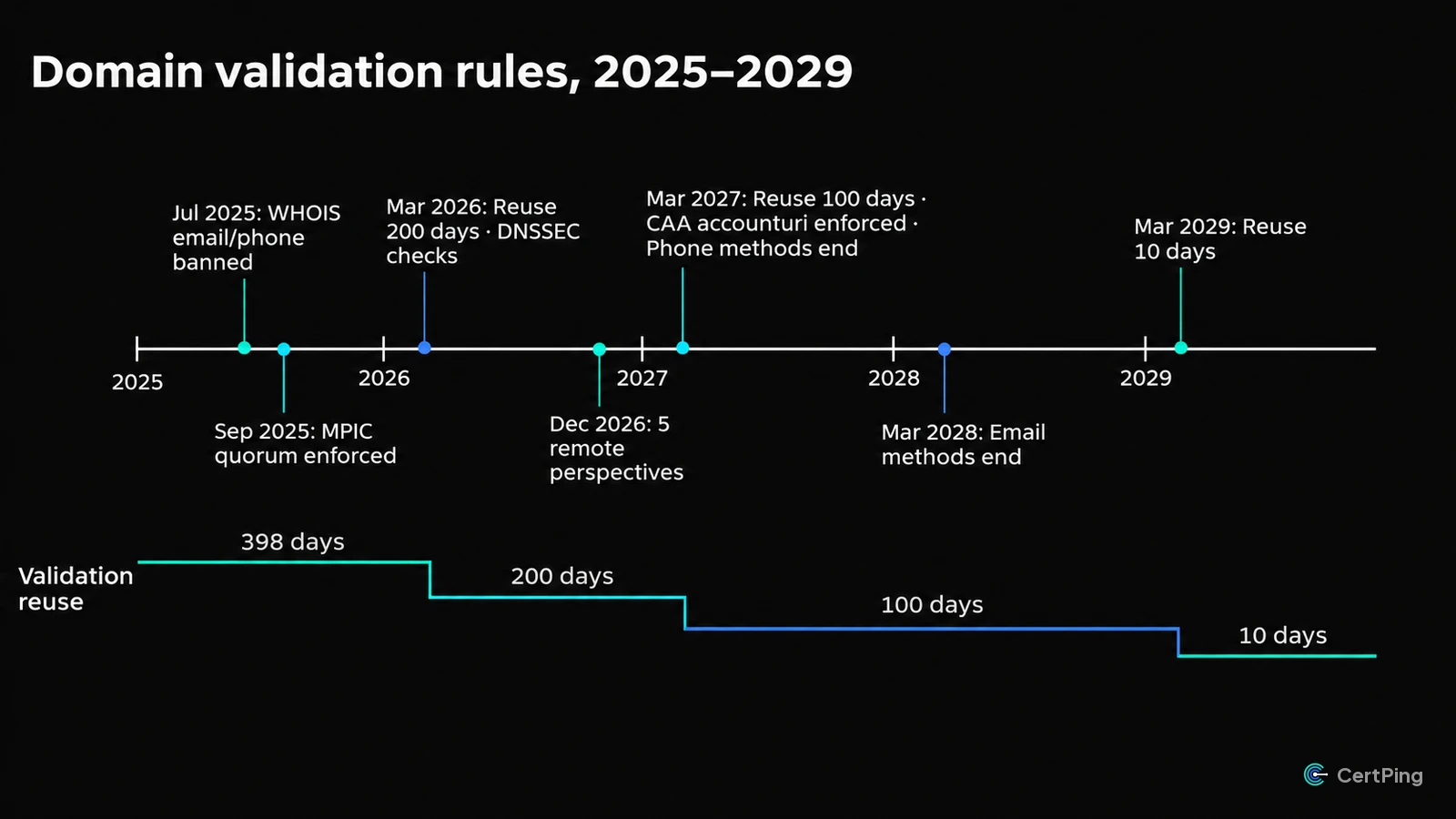
- Validation through WHOIS contacts has been banned since 15 July 2025, after the 2024 .mobi WHOIS research. Email to addresses such as admin@ must stop by 15 March 2028.
- CAs must repeat DNS and website validations and CAA checks from several network locations (MPIC). From 15 December 2026 that means at least five remote perspectives.
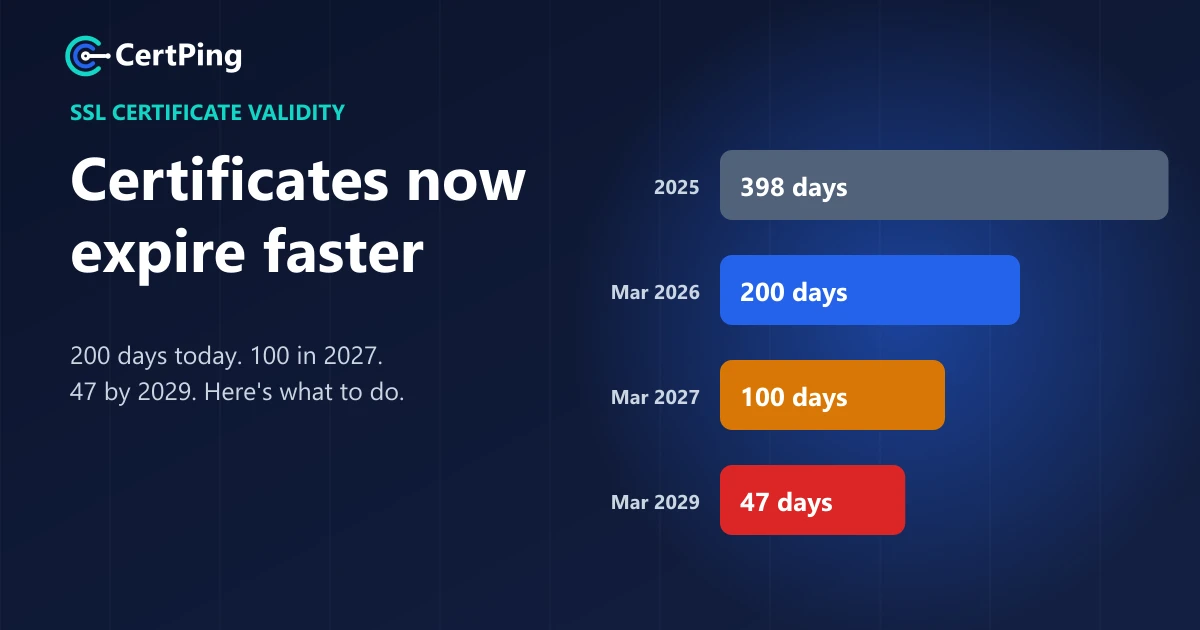
- A CA may reuse a past validation for 200 days today, 100 days from 15 March 2027 and 10 days from 15 March 2029, so almost every renewal will mean a fresh validation.
- From 15 March 2027, CAs must honour two settings in your CAA record (the DNS record that lists which CAs may issue), so you can pin issuance to one account and one method.
What is domain control validation?
Domain control validation is the check a CA performs to confirm that whoever requests a certificate controls each domain name in it. The rules come from the CA/Browser Forum's Baseline Requirements (BRs), the rulebook browsers require every publicly trusted CA to follow. Section 3.2.2.4 numbers the allowed methods, such as 3.2.2.4.7, "DNS Change".
Each method asks you to publish a random value, an unguessable string from the CA, which proves the person answering is the person who asked. Some methods can validate a parent name, so validating example.com can cover shop.example.com.
For a DV certificate, DCV is all there is. Nobody checks a company or a passport, which is why a real padlock can sit on a fake site when an attacker controls the DNS.
Which DCV methods can a CA use today?
The current BRs (version 2.3.1, October 2026) number 22 methods under 3.2.2.4. Ten are retired and marked "MUST NOT be used". These are the ones you will meet.
DNS change (3.2.2.4.7 and ACME dns-01)
You publish the CA's value in DNS, in a TXT, CNAME or CAA record at the name itself or at a label starting with an underscore. ACME, the protocol behind Let's Encrypt and most automated issuance (RFC 8555), defines dns-01: a TXT record at _acme-challenge holding a digest of the token and your account key.
_acme-challenge.example.com. 300 IN TXT "gfj9Xq...Rg85nM"
Sectigo's DNS method uses a CNAME built from hashes of your certificate signing request (CSR), as its DCV documentation describes:
_<MD5 of CSR>.example.com. CNAME <first half of SHA-256>.<second half of SHA-256>.sectigo.com.
Where it fails: anyone who can edit your zone passes it, including whoever holds a leaked DNS API key. It also fails quietly when your nameservers disagree and the CA asks one that has not received the record yet.
dns-account-01 and dns-persist-01 (3.2.2.4.21 and 3.2.2.4.22)
Two newer DNS methods fix specific problems with dns-01. dns-account-01, added by ballot SC-084, puts the record under a label derived from your ACME account, _<label>._acme-challenge.example.com, so two systems (say, two CDNs) can validate the same name without fighting over one record. Its IETF specification, draft-ietf-acme-dns-account-label, was in IESG evaluation in late November 2026 and is not yet an RFC.
dns-persist-01, added by ballot SC-088, lets you publish one standing TXT record at _validation-persist naming the CA and your account, instead of a new record per order. The record can stay for years, but the CA must re-read it at least every 10 days. Let's Encrypt announced support in February 2026 and runs it in staging; as of mid-2026 it had paused the production rollout until the IETF draft settles.
HTTP file (3.2.2.4.18, 3.2.2.4.19 and ACME http-01)
You serve the CA's value from a file on the website: under /.well-known/pki-validation/ for the generic method, or /.well-known/acme-challenge/<token> for ACME http-01. Let's Encrypt starts the check on port 80 and follows up to 10 redirects (challenge types).
Where it fails: port 80 must be reachable from the internet, every server behind a load balancer must answer, and anyone who can drop a file in that path passes. It proves control of one host only, so it cannot validate a wildcard or a parent name.
TLS-ALPN-01 (3.2.2.4.20)
The CA connects on port 443 asking for a special protocol, acme-tls/1, and your server answers with a temporary self-signed certificate carrying the value (RFC 8737). It suits TLS-terminating proxies that never open port 80. Like HTTP, it proves one host and cannot validate wildcards.
Email to a constructed address (3.2.2.4.4)
The CA emails a random value to admin@, administrator@, webmaster@, hostmaster@ or postmaster@ the domain, and you send it back. Where it fails: anyone who can create or read one of those mailboxes, including a catch-all, can approve a certificate. Ballot SC-090 phases it out: CAs should not use it from 15 March 2026 and must not rely on it from 15 March 2028. The same ballot ends phone validation through contacts published in DNS (3.2.2.4.16 and .17) on 15 March 2027, and email to those contacts (3.2.2.4.13 and .14) on 15 March 2028.
Email or phone to WHOIS contacts (retired)
Methods 3.2.2.4.2 (email, fax, SMS or post to the domain contact) and 3.2.2.4.15 (phone to the domain contact) found the contact in WHOIS. Both are retired; the next sections explain why. A related method, 3.2.2.4.12, survives only when the CA is also the domain's registrar, or an affiliate, and uses its own records.
Which validation methods can issue wildcard certificates?
A wildcard such as *.example.com covers names that may not exist yet. A file on one host says nothing about hosts you have not built. So the BRs allow wildcards only for methods that prove control of the whole zone: DNS change, dns-account-01, dns-persist-01, the remaining email and phone methods, and the registrar method. The HTTP and TLS-ALPN methods may not validate wildcards, parent names or CNAME targets. Let's Encrypt puts it plainly: http-01 "cannot be used to issue wildcard certificates".
Once the email and phone methods end in 2028, a wildcard will need a DNS method, unless your CA is also your registrar.
Why was WHOIS-based validation removed?
On 11 September 2024, watchTowr published research on the .mobi WHOIS server. The registry had moved WHOIS to a new hostname, and the old domain, dotmobiregistry.net, had lapsed. watchTowr registered it for about $20 and ran a WHOIS server under the old name. Between 30 August and 4 September 2024, it logged over 2.5 million queries from more than 135,000 systems still using the old address.
The certificate angle was the alarming part. When watchTowr served a fake WHOIS record for microsoft.mobi, GlobalSign's system accepted an address at watchTowr as a valid approval email for that domain. watchTowr issued nothing, but the lesson was clear: whoever answers the WHOIS lookup chooses who approves the certificate.
The CA/Browser Forum moved quickly. Ballot SC-080, proposed within weeks, cites "a recent disclosure" that threat actors could exploit WHOIS. From 15 January 2025, CAs may not take domain contacts from HTTPS websites and must follow stricter WHOIS and RDAP lookup rules. From 15 July 2025, they must not issue using methods 3.2.2.4.2 or 3.2.2.4.15 at all.
What is multi-perspective issuance corroboration (MPIC)?
MPIC means the CA repeats each validation and CAA check from several network locations far apart, and issues only if enough of them agree with its primary check. It exists because internet routing (BGP) can be lied to. An attacker who announces a more attractive route to your IP addresses can, for a few minutes, receive the traffic some networks send to your server, including the CA's validation request. Princeton researchers demonstrated this against real CAs in Bamboozling Certificate Authorities with BGP (USENIX Security 2018), and the MPIC ballot cites real hijacks against KlaySwap and Celer Bridge. Such hijacks are usually local: from another continent, the CA still reaches your real server.
Let's Encrypt has validated from several perspectives since February 2020. Ballot SC-067 made it mandatory for every CA, phased in under BR section 3.2.2.9:
- 15 March 2025: at least 2 remote perspectives, but a failed quorum need not yet stop issuance.
- 15 September 2025: quorum must be met, or no certificate.
- 15 March 2026: at least 3 remote perspectives, spanning at least 2 regional internet registry (RIR) regions.
- 15 June 2026: at least 4 remote perspectives.
- 15 December 2026: at least 5 remote perspectives.
With 2 to 5 remote perspectives one may disagree; with 6 or more, two may. Perspectives must be at least 500 km apart. Separately, ballot SC-085 has required CAs since 15 March 2026 to validate DNSSEC, where a domain has it, on CAA and DCV lookups.
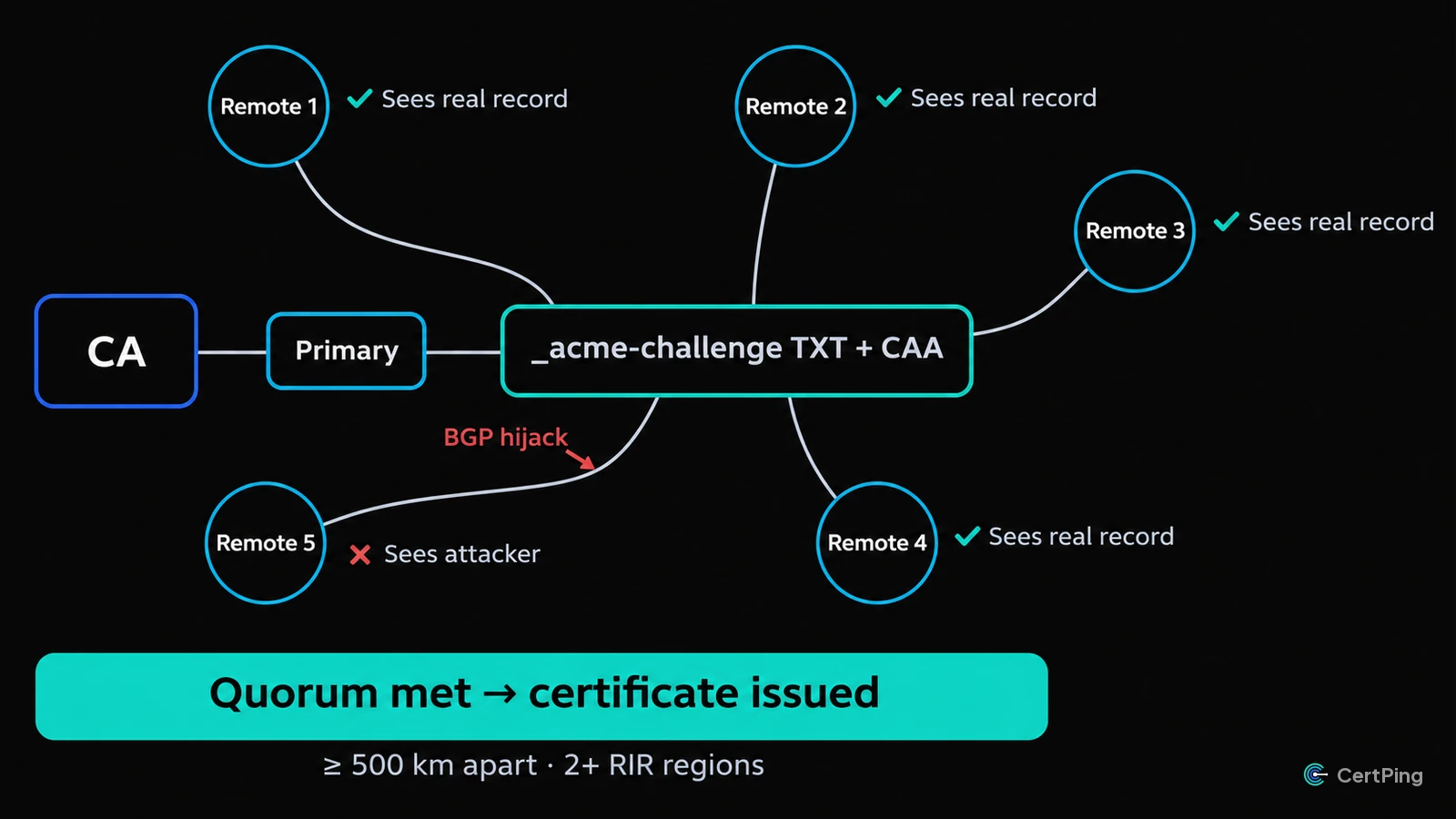
MPIC protects the path between the CA and your servers. It does nothing if an attacker changes your records at your DNS provider, registrar or registry, because then every perspective sees the attacker's answer.
How do CAA records interact with domain validation?
A CAA (Certification Authority Authorization) record lists the CAs allowed to issue for your domain; our padlock article covers why to publish one. During validation:
- The CA looks up CAA for every name in the certificate, using the closest record set up the DNS tree (RFC 8659), and MPIC corroborates that lookup too.
issueauthorises a CA,issuewildoverrides it for wildcard names, andiodefgives an address for reports.- RFC 8657 adds two parameters:
accounturilimits issuance to one account at that CA, andvalidationmethodslimits which DCV methods it may use.
example.com.  CAA 0 issue "letsencrypt.org; validationmethods=dns-01"
example.com.  CAA 0 issue "sectigo.com"
example.com.  CAA 0 issuewild "sectigo.com"
example.com.  CAA 0 iodef "mailto:security@example.com"
This says: Let's Encrypt may issue only after a dns-01 check, Sectigo may issue, and only Sectigo may issue wildcards. Today the BRs say CAs SHOULD process the RFC 8657 parameters; ballot SC-098 makes it a MUST from 15 March 2027. Let's Encrypt already supports both, so a hijacked web server alone cannot get a Let's Encrypt certificate for your name. It could still try Sectigo, which this record allows with any method. Add validationmethods to every issue line, and remember that CAs only have to honour it from 15 March 2027.
How long can a CA reuse a past validation?
Once a CA has validated a name, it may reuse the result for later certificates for a limited time. Ballot SC-081, the same ballot that shortens certificate lifetimes to 47 days, shrinks that window (BR section 4.2.1):
- Before 15 March 2026: 398 days.
- From 15 March 2026 (now): 200 days.
- From 15 March 2027: 100 days.
- From 15 March 2029: 10 days.
CAs can be stricter. Let's Encrypt's profiles page lists 30 days of reuse for its classic profile and 7 hours for its 45-day tlsserver profile.
What does this mean for your domains?
Whoever controls your DNS or web server can get certificates for your names
Every method reduces to "can you change something the CA can see". A registrar login, a DNS API key, a CI job with DNS credentials, a hosting file manager: each is a certificate-issuing credential. Treat it that way.
Automation matters more as reuse shrinks
With fresh validation at almost every renewal, a manual step comes up about every six weeks per name by 2029. ACME with dns-01 is the most flexible choice: it works behind firewalls, for hosts that are not public, and for wildcards.
Delegate _acme-challenge with a CNAME instead of handing out full DNS API keys
Most DNS providers' API keys can edit every record in a zone. Put one on a web server and a breach of that server becomes a breach of your DNS, a risk Let's Encrypt's docs warn about. The usual fix is CNAME delegation, which Let's Encrypt supports:
- Create a small zone used only for validation, for example
acme-validation.example.net. - In your main zone, add one fixed record:
_acme-challenge.example.com. CNAME example-com.acme-validation.example.net. - Give the ACME client credentials for the validation zone only.
- The CA follows the CNAME and reads the TXT record there.
Two cautions. The validation zone now controls issuance for your name, so protect it like your main zone. And keep its domain renewed: a lapsed target domain is the .mobi mistake again.
OV and EV validation is separate
Organisation-validated (OV) and extended-validation (EV) certificates add checks on the company behind the request. Those identity checks may be reused for up to 398 days, but they sit on top of DCV, which follows the same shrinking schedule.
How do I check who can get a certificate for my domain?
- Read your CAA records. No output means any CA may issue.
dig +short CAA example.com
- Look for challenge records. A stale TXT is harmless, but a CNAME you did not create points to someone who can validate your name.
dig +short TXT _acme-challenge.example.com
dig +short CNAME _acme-challenge.example.com
- Read Certificate Transparency. Search crt.sh for
example.comand%.example.comto see every logged certificate for your names and subdomains, and which CA issued each. Look-alike names will not show up here. - Match issuers to CAA. Every issuer you see should be one you use and one your CAA records allow.
- List who can validate. Note every person and system that can edit your DNS or serve files on your domains, and remove what you do not need.
How CertPing fits
CertPing issues free Let's Encrypt certificates and sells Sectigo PositiveSSL, Multi-Domain and Wildcard certificates (pricing). All are DV certificates, validated through DNS:
- Let's Encrypt certificates are validated with ACME dns-01. CertPing does not use HTTP or TLS-ALPN validation.
- Sectigo certificates are validated with Sectigo's DNS CNAME method, never by email. Before ordering from Sectigo, CertPing checks that your CAA records allow Sectigo and that the validation records answer on every authoritative nameserver.
- On CertPing DNS, CertPing writes and checks the validation records for you, and renewing a Let's Encrypt certificate is one click in the dashboard.
- If your DNS is elsewhere, CertPing shows you the TXT or CNAME records to add. CertPing then has no access to your DNS, so you renew by hand.
- CertPing DNS supports CAA records and DNSSEC signing.
CertPing does not sell OV or EV certificates on its public plans.
Frequently asked questions
Can I still validate an SSL certificate by email?
For now, yes, but only through constructed addresses such as admin@ or contacts published in DNS. CAs should already avoid these methods and must stop relying on them by 15 March 2028. Validation through WHOIS email contacts ended on 15 July 2025.
Why can't I use HTTP validation for a wildcard certificate?
HTTP validation proves control of one host, not of the whole zone. A wildcard covers names that may not exist yet, so the Baseline Requirements allow only zone-level methods, such as DNS, to validate it.
What does the _acme-challenge TXT record do?
It holds the value your ACME client publishes to answer a dns-01 challenge, and the CA reads it to confirm you control the domain. Most clients delete it afterwards. It can also be a CNAME to a separate zone used only for validation.
How often will my domain be validated by 2029?
From 15 March 2029, a CA may reuse a validation for at most 10 days, and certificates last at most 47 days. Expect a fresh validation at almost every renewal, which is why automated DNS validation matters.
Does MPIC stop DNS hijacking?
No. It stops attacks on the network path between the CA and your servers, such as BGP hijacks. If an attacker changes your records at your DNS provider, registrar or registry, every perspective sees the false answer, so account security still matters most.
Do OV and EV certificates skip domain validation?
No. They add checks on the organisation, but every name in the certificate still needs domain control validation on the same reuse schedule as a DV certificate.
Sources
- CA/Browser Forum Baseline Requirements for TLS server certificates, v2.3.1: sections 3.2.2.4, 3.2.2.9, 4.2.1, 4.2.2.1
- Ballot SC-067: multi-perspective issuance corroboration
- Ballot SC-080: sunset WHOIS-based domain contacts and methods
- Ballot SC-081: reducing validity and data reuse periods
- Ballot SC-084: dns-account-01 validation method
- Ballot SC-085: DNSSEC validation for CAA and DCV lookups
- Ballot SC-088: DNS TXT record with persistent value
- Ballot SC-090: sunset email and phone validation methods
- Ballot SC-098: process RFC 8657 CAA parameters
- RFC 8555: ACME, RFC 8657: CAA account and method binding, RFC 8659: CAA, RFC 8737: TLS-ALPN-01
- IETF draft: ACME dns-account-01
- Let's Encrypt: challenge types, CAA, profiles, multi-perspective validation (2020), DNS-PERSIST-01 (2026)
- Sectigo: DCV methods
- watchTowr Labs: the .mobi WHOIS research (September 2024)
- Birge-Lee et al., Bamboozling Certificate Authorities with BGP (USENIX Security 2018)