Fake 'Delivery Failed' Texts Peak After Cyber Monday. What to Tell Your Customers and Your Team
Package delivery texts are the most-reported text scam, and they surge in the weeks after Black Friday and Cyber Monday. How the scam works, how it borrows your business's name, and a short plan to protect customers and staff.
Black Friday is this week and Cyber Monday follows on 30 November. Millions of parcels will be on the road, and almost everyone will be waiting for at least one. That is exactly why the next few weeks are the busiest season for one of the simplest scams there is: a text saying your package could not be delivered.
If you run a business that ships anything, the scam is not only your customers' problem. Many of these messages borrow a real company's name, and the next one could borrow yours. Here is how it works and what to put in place before the rush.
How big the problem is
According to the US Federal Trade Commission, messages about package deliveries, "usually from someone pretending to be from the U.S. Postal Service, were the most reported text scam" in 2024. People reported $470 million in losses to text scams overall that year, more than five times the 2020 figure. The FTC also notes that "many people reported paying a small 'redelivery fee' that turned out to be a trick to get their credit card or even Social Security number."
Holiday timing makes it worse. As cited in recent consumer coverage, the security firm Darktrace estimated that holiday-themed phishing rose 692% in the last week of November 2025 compared with the first week.
How the scam works
The pattern hardly changes from year to year:
- A short text arrives, often from an unknown number or email address: "Your package could not be delivered due to an incomplete address", "A delivery attempt failed" or "A customs fee of $2.99 is due."
- A link points to a page that looks like a carrier or a store, on a look-alike address such as
usps-redelivery-help.comoryourstore-tracking.info. - The page asks for a tiny payment or "to confirm your details". The fee is small so people do not think twice. The real target is the card number, the address and sometimes a login.
- The data is reused for bigger charges, account takeovers or more convincing scams later.
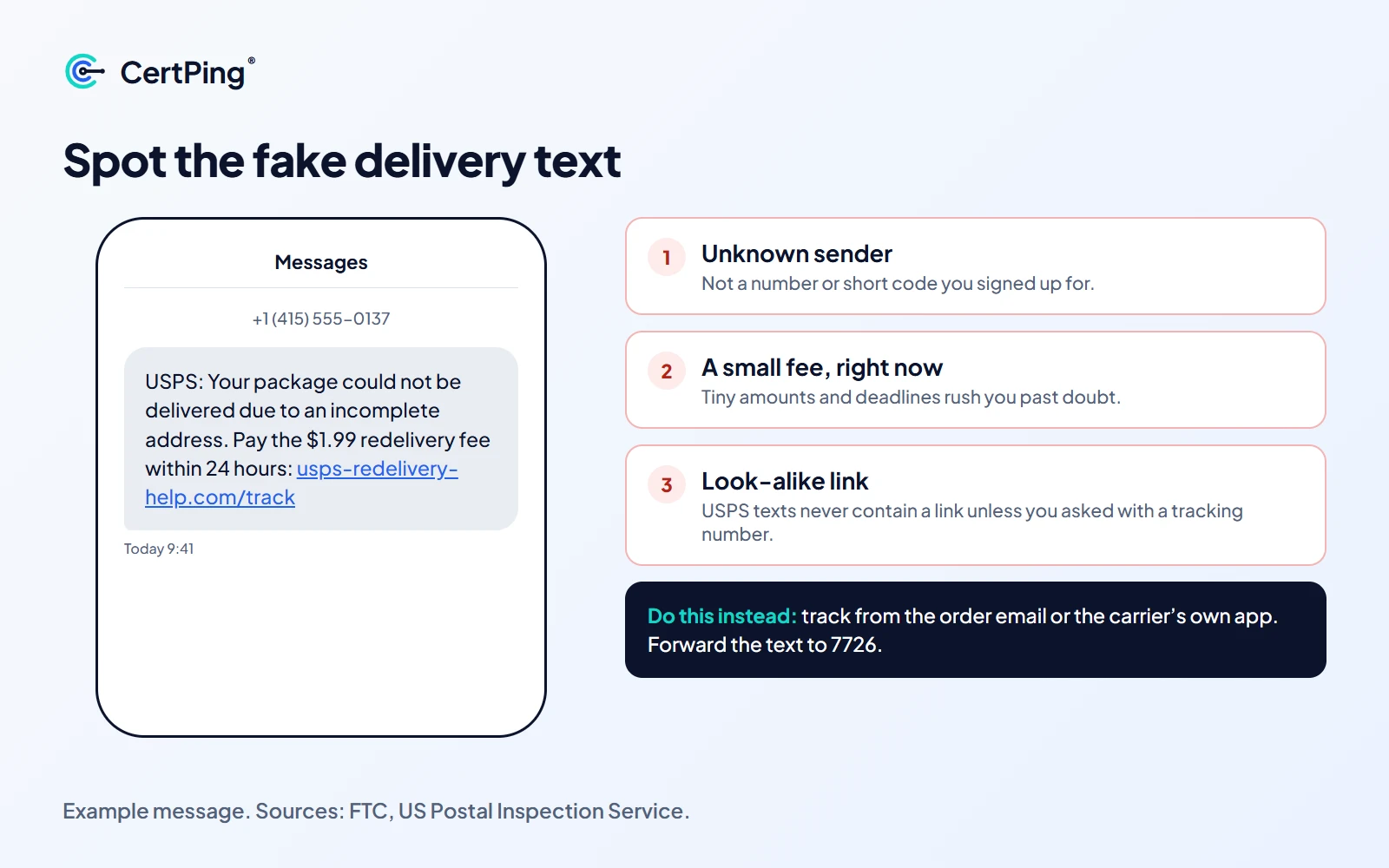
The official line from the US Postal Inspection Service is simple: USPS "will not send customers text messages or e-mails without a customer first requesting the service with a tracking number, and it will NOT contain a link." Any USPS-branded text with a link that you did not sign up for is fake.
Why your business's name is at risk too
Scammers go where the trust is. Once customers have ordered from you, a message that seems to come from your shop or your shipping partner feels expected. To make that work, scammers:
- Register look-alike domains of your name: an extra word (
-delivery,-tracking,-support), a swapped letter or a different ending, such as.shopinstead of.com. - Copy your branding from your own website and emails.
- Send texts and emails that match your real order and shipping messages closely enough to pass a quick glance.
The customer who pays a fake "redelivery fee" in your name will often contact you, not the scammer, when they realise. That costs you support time, refunds you do not owe and some of their trust.
A short plan for the next four weeks
1. Tell customers how you will contact them
Add one clear line to your order confirmation emails, your checkout page and your FAQ:
"We will never text you a link asking for a delivery fee or your card details. To track an order, sign in at yourcompany.com or use the tracking number in your order email."
If you do send delivery texts, say which sender name or short code you use, and never include payment links in them.
2. Make sure your real emails cannot be spoofed
Set up SPF, DKIM and DMARC on your domain, and move DMARC towards p=quarantine or p=reject once your legitimate senders pass. This stops scammers sending email that claims to come from your exact domain. It does not stop look-alike domains, which is why the next step matters.
3. Know which look-alikes of your name exist
Check which close imitations of your domain are already registered, and keep watching for new ones through the season. A look-alike registered in late November with "delivery", "track" or "refund" in the name deserves attention.
4. Brief your team in five minutes
Your support and finance staff will see these scams from both sides: customers forwarding suspicious texts, and staff receiving fake "failed delivery" messages about supplies they ordered. Agree on three rules:
- Never pay a delivery or customs fee from a link in a text. Check with the carrier using the tracking number from the original order.
- Forward suspicious customer reports to one person who can check look-alike domains and warn others.
- Do not tell customers "that wasn't us" and stop there. Point them to your official tracking page and to the FTC's reporting site.
5. Have a reporting routine ready
When a customer sends you a fake text in your name, keep the message and the link (without clicking it), and note the sending number and the look-alike domain. Report the text by forwarding it to 7726 (SPAM) in the US, report the fraud at ReportFraud.ftc.gov, and report the domain to its registrar's abuse contact. Then send a short note to customers if the same lure is going round.
What to tell customers who ask "Is this real?"
Keep a ready answer that support can paste:
- Do not tap the link or reply.
- Track the order from the email we sent when you ordered, or sign in at our website.
- If you already entered card details, call your bank using the number on the back of your card.
- Forward the text to 7726 and delete it.
Where CertPing fits
CertPing is a domain trust platform that helps you protect the name your customers recognise:
- Free look-alike domain checker: see which of the 36 most common imitations of your domain are already registered. It is free and needs no account.
- Phishing watch: CertPing checks new registrations daily for look-alikes of your domain and alerts you with the domain, the reason it matched and a risk level, so you can investigate and escalate.
- Email security: set up SPF, DKIM and DMARC in one step, with a guided path from monitoring to quarantine and reject, so scammers cannot send email from your exact domain.
- Your first Domain Security bundle is free: a look-alike phishing watch for one domain, email security for one domain and a USPTO watch for one trademark.
To be clear about the limits: CertPing does not read or block text messages, and it does not take look-alike sites down for you. It finds look-alikes early and helps you work each one through investigation, evidence and escalation, so you can warn customers before the scam reaches them.
Frequently asked questions
Does USPS send texts about failed deliveries?
Only if you signed up for text updates with a tracking number, and even then the message will not contain a link. A USPS text with a link that you did not request is a scam.
Why do scammers ask for such a small fee?
A $1 to $3 charge feels too small to question. The goal is your full card details, address and sometimes your login, which are then used for larger fraud.
Can DMARC stop fake delivery texts?
No. DMARC protects email sent from your exact domain. Texts and look-alike domains need different defences: clear customer messaging, look-alike monitoring and reporting.
What should a business do if scammers use its name?
Collect the messages and domains, report them (7726 for texts, ReportFraud.ftc.gov, and the registrar's abuse contact for domains), warn customers through your own channels and keep watching for new look-alikes.
Sources: FTC Data Spotlight, "Top text scams of 2024", 14 April 2025; US Postal Inspection Service, "Smishing: Package Tracking Text Scams"; Rough Draft Atlanta, "Black Friday and Cyber Monday scams to watch for this year", 25 November 2026 (citing Darktrace).